

Volatile commodity prices, geopolitical tension and ever-stricter sustainability requirements have made procurement one of the hardest jobs in the oleochemical, soap and cosmetics industries. Securing consistent volumes of high-grade raw material is now a daily challenge. In this environment, choosing a crude vegetable oil supplier can no longer come down to the price per tonne. It is a strategic decision that directly affects your plant yields, your refining costs and your brand reputation.
West Africa is fast becoming a first-choice sourcing region for buyers in Europe, Asia and the Americas. Backed by rapidly modernised infrastructure, TCHAOU GROUP MANUFACTURE has established itself in Benin as a reliable industrial partner, raising the bar for direct, at-source sourcing. If you are still weighing crude against refined grades, start with our guide to crude and refined vegetable oils in Africa.
Why buying direct from the manufacturer changes everything
Commodity oils have traditionally changed hands through a long chain of brokers and trading houses based thousands of kilometres from the fields. Every extra link in that chain creates three problems for industrial buyers:
- Lost traceability: you cannot tell which cooperatives grew the seeds and kernels, or whether they follow sustainable farming practices.
- Degraded quality: repeated transshipment and long stays in uncontrolled warehouses accelerate the oxidation of crude oil.
- Inflated costs: each intermediary adds its margin, pushing up your final FOB or CIF price.
When your crude vegetable oil supplier is also the processor, as TCHAOU GROUP MANUFACTURE is, those risks disappear. You deal directly with the mill, you know exactly where your raw material comes from, and you receive freshly pressed oil that conventional trading channels simply cannot match.
Three technical criteria to assess a crude vegetable oil supplier
Before you sign a supply contract or commit volumes for your next production campaign, your lab team should validate the industrial capability of the partner. A strong supplier masters three fundamentals of crude vegetable oil manufacturing.
1. Tight control of free fatty acids (FFA)
FFA is the ultimate test of a crude oil. A high FFA level shows that fruit or kernels waited too long before pressing, triggering enzymatic breakdown. For oil destined for refining, high FFA means greater neutral oil loss and heavier chemical consumption during neutralisation. Your supplier should be able to prove that it presses fresh raw material and stabilises it immediately, with acidity measured by a recognised method such as ISO 660.
2. 100% mechanical extraction
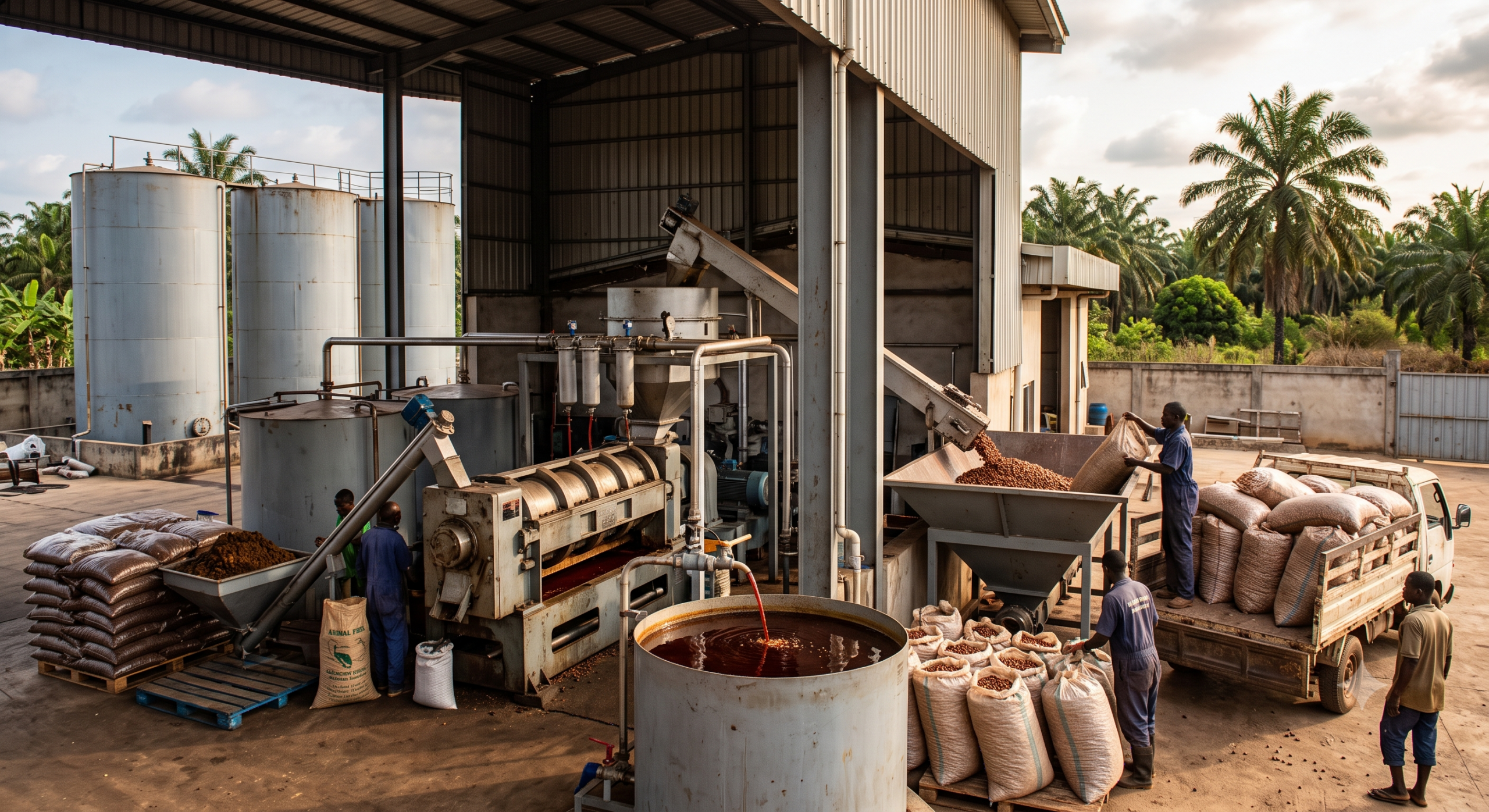
Many high-volume processors use chemical solvents such as hexane to strip the last drop of oil from the press cake. Natural cosmetics and pharmaceutical manufacturers, however, now demand oils free of any chemical residue. A supplier equipped with continuous screw presses guarantees native purity and compliance with the strictest environmental labels. Learn more about our approach as a manufacturer of first cold-pressed vegetable oils.
3. Reliable storage and processing capacity
A plant cannot stop for lack of raw material. Your industrial partner needs a robust collection network of cooperatives and smallholders, plus industrial-scale storage, to keep deliveries flowing even during the agricultural lean season.
TCHAOU GROUP MANUFACTURE: your strategic partner in West Africa
Based in Benin, TCHAOU GROUP MANUFACTURE designed its production facility around the requirements of the most demanding international buyers.
| What B2B buyers look for | How the manufacturer delivers |
|---|---|
| Purity and traceability | Local sourcing from selected cooperatives and solvent-free mechanical pressing. |
| Consistent quality | Advanced filtration and centrifugation, keeping moisture and impurities below 1%. |
| Volume flexibility | Capacity to honour long-term contracts with scheduled, staggered deliveries. |
| Logistics advantage | Fast access to the deep-water Port of Cotonou for shipments worldwide. |
Whether you supply soap makers across Africa, cosmetics plants in Europe or refineries in Asia buying crude palm kernel oil (CPKO), the group adapts to the technical specifications of each sector. The product range also includes extra virgin soybean oil, cold-pressed baobab oil, cold-pressed neem oil and raw shea butter.
Shipping and compliance: mastering international bulk logistics
Being a good crude vegetable oil supplier also means being an expert in international logistics. Moving fats and oils across continents requires dedicated equipment to prevent any deterioration at sea.
The group routinely uses modern bulk solutions, starting with flexitanks fitted inside 20-foot containers. A flexitank turns a standard container into a clean, single-use tank holding up to 24,000 litres, sharply cutting packaging and handling costs compared with steel drums. For specialty lots or mid-sized volumes, IBC totes provide reliable protection against oxidation. Shipments leave from the Port Autonome de Cotonou, Benin’s maritime gateway.
Frequently asked questions
What is the difference between crude and refined vegetable oil?
Crude oil comes straight from pressing and filtration, with no neutralisation, bleaching or deodorisation. It keeps its natural compounds and serves as the feedstock for refineries, soap makers and cosmetic laboratories.
Which documents should I request from a crude oil supplier?
Ask for a certificate of analysis for each lot (acidity, moisture, impurities, peroxide value), a description of the extraction process and proof of raw-material origin. Reference specifications are published in the Codex Alimentarius standards.
Which crude oils work best for soap making?
Crude palm kernel oil is one of the most widely used, prized for lather and bar hardness. Read more in the importance of crude palm kernel oil in soap making.
Conclusion: secure your supply chain today
Transparency and resilience have become top priorities in every supply chain. Partnering with a solid, transparent crude vegetable oil supplier is now a real competitive advantage.
By working with TCHAOU GROUP MANUFACTURE, you do more than sign a sourcing contract: you bring a modern African manufacturer into your value chain, focused on technical performance, ethical collection and logistics excellence. As global markets look to Africa to diversify supply, put your business at the source of crude-oil quality.
Planning your next purchasing campaign? Request a quote and technical data sheet from our export team.