



Crude and refined vegetable oils serve very different industrial needs, and choosing the right grade can save a buyer significant processing costs. Crude vegetable oils are mechanically pressed and keep their natural compounds. Refined vegetable oils are purified to be neutral, stable and standardized. In this complete guide, discover the 5 key differences, the 4 refining steps and how to source both grades from Africa.
In the global fats and oils industry, the step from crude to refined oil is one of the most value-creating segments of the chain. Whether you supply major food manufacturers, cosmetic laboratories or chemical plants, the choice between crude and refined vegetable oils depends strictly on your downstream process.
For international buyers, securing supply at source from an operator who masters both forms has become a key factor in logistics and economic performance. In Benin, TCHAOU GROUP MANUFACTURE supplies both grades, with crude oils selected for low free fatty acid content and easy refining.
What are crude and refined vegetable oils?
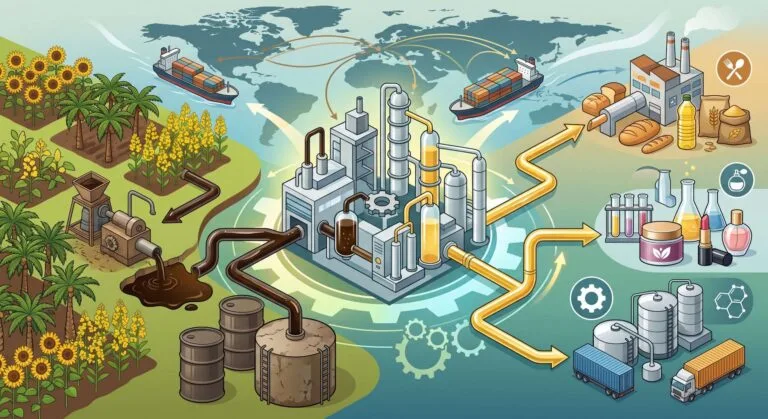
Every vegetable oil starts as a crude oil. Seeds, kernels or fruit pulp are pressed mechanically, and the oil that flows from the press is filtered to remove solid particles. At this stage, it still contains all the natural compounds of the raw material.
A refined oil is simply a crude oil that has gone through a series of purification steps. Refining removes the components that affect taste, colour, odour and shelf life. The result is a neutral, uniform product that behaves the same way from one batch to the next. For a general overview, see the vegetable oil entry on Wikipedia.
Crude and refined vegetable oils: 5 key differences
To optimize formulation costs, engineers and purchasing managers need to segment the use of these two product categories clearly. Here are the five differences that matter most.
1. Natural composition
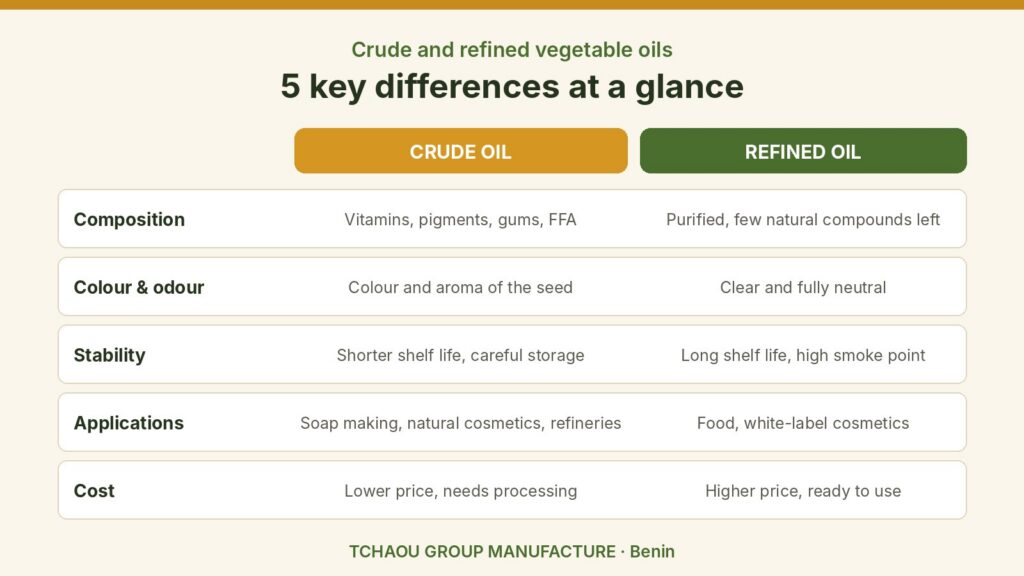
Crude oils retain all their native components: vitamins, pigments and antioxidants, but also gums (phosphatides) and free fatty acids. Refined oils lose most of these compounds, the useful ones as well as the undesirable ones.
2. Colour, odour and taste
A crude oil carries the colour and aroma of its source seed. A refined oil is clear, light in colour and fully neutral after deodorization, so it does not interfere with fragrances or flavours.
3. Stability and shelf life
Refining removes the free fatty acids that speed up oxidation. Refined oils therefore keep longer and have a higher smoke point, while crude oils must be stored and shipped with more care.
4. Typical applications
Crude oils suit industries with their own processing units and applications where native compounds are an advantage, such as cold-process soap making or natural cosmetics. Refined oils are essential for white-label cosmetic formulations and mass-market food production.
5. Cost and processing
Crude oil is cheaper per tonne but requires processing capacity on the buyer’s side. Refined oil costs more but is ready to use. The right choice depends on your plant, your volumes and your end product.
How crude vegetable oils are refined: the 4 main steps
Industrial refining follows a well-established sequence. Each step targets a specific group of impurities.
- Degumming: water or acid treatment removes phosphatides (gums), which would otherwise cause deposits and cloudiness.
- Neutralization: free fatty acids are removed, either chemically with an alkali or physically by steam distillation later in the process.
- Bleaching: bleaching earth absorbs pigments, traces of metals and oxidation products to lighten the colour.
- Deodorization: high-temperature steam under vacuum strips out volatile compounds responsible for odour and taste.
Every one of these steps becomes heavier and more expensive when the crude oil is of poor quality. That is why the quality of crude and refined vegetable oils is so closely linked.
Why crude oil quality determines refined oil quality
The quality of a refined oil always depends on the crude oil it comes from. If the crude oil has too high a free fatty acid (FFA) content or excessive impurities, refining becomes energy-intensive and causes major yield losses.
This is where TCHAOU GROUP MANUFACTURE makes the difference. Raw materials such as palm kernels, neem seeds and baobab are pressed quickly after collection, which prevents the activation of the enzymes responsible for fat hydrolysis. The mechanically pressed crude oil is stable, so downstream refining is easier, yields are higher and processing costs are lower for end buyers.
Quality standards for crude and refined vegetable oils
To guide brokers and secondary processing plants in Asia, the Americas and Africa, here are the analytical criteria that distinguish crude oil from refined oil:
| Control parameter | Crude (press output) | Refined (industrial standard) | Formulation impact |
|---|---|---|---|
| Appearance and colour | Variable, rich in natural pigments | Clear, standardized colour (low Lovibond) | Visual neutrality of the finished product |
| Odour and flavour | Characteristic of the source seed | Fully neutral after deodorization | No interference with fragrances |
| Free fatty acids (FFA) | < 5% depending on the seed | < 0.1% | Maximum stability against rancidity |
| Insoluble impurities | < 0.2% | Undetectable traces | Purity required for emulsions |
| Solvent residues | 0% (mechanical extraction) | 0% | Essential for eco-certified labels |
Acidity is measured with recognised methods such as ISO 660. Ask your supplier for a certificate of analysis for every lot.
Which crude and refined vegetable oils come from Africa?
West Africa produces a wide range of oilseeds, each with its own industrial outlets. TCHAOU GROUP MANUFACTURE supplies, among others:
- Crude palm kernel oil: the reference oil for soap making and oleochemicals. Learn more in our crude palm kernel oil supplier guide.
- Soybean oil: used in cosmetics, food and animal feed.
- Cold-pressed baobab oil: a premium oil for skin and hair care.
- Cold-pressed neem oil: valued in organic agriculture and natural cosmetics.
- Raw shea butter: a staple of cosmetics and soap making.
Browse the full crude vegetable oil catalogue for specifications and packaging options.
Target markets for crude and refined vegetable oils
Demand for crude and refined vegetable oils varies by region, and the group’s export infrastructure is configured to meet each set of requirements.
African and regional markets
Demand across Africa is twofold. Local soap and detergent industries are major consumers of crude oils such as crude palm kernel oil. The consumer goods sector requires refined oils that meet public health standards and remain stable in tropical climates.
North American and European markets
In Europe and North America, natural cosmetics and pharmaceutical laboratories seek highly purified oils with ethical and environmental traceability, and they reject oils linked to large-scale deforestation. Sourcing from wild harvests and small sustainable cooperatives in Benin is a major selling point in these premium markets.
Asian markets
Asia, the global hub of oleochemicals, absorbs massive volumes of crude oils to feed its own large refineries. For these buyers, the group positions itself as a crude vegetable oil supplier able to guarantee steady flows and optimized sea freight through the Port of Cotonou.
Shipping crude and refined vegetable oils internationally
Transporting vegetable oils, crude or refined, requires temperature control and proper packaging to prevent crystallization and oxidation. To serve customers worldwide, the plant uses modern, flexible shipping solutions:
- Containers with flexitanks: ideal for bulk export of crude oils to large international refineries. They maximize usable volume per container while ensuring a fully leak-proof seal.
- IBCs and sealed drums under nitrogen: mainly used for refined oils and specialty cosmetic oils such as neem and baobab. This packaging prevents contact with oxygen and preserves freshness until the oil is opened at the customer’s plant.
How to choose between crude and refined vegetable oils
Answer these four questions before you place your order:
- Do you have refining capacity? If yes, crude oil gives you more control over quality and a lower purchase price.
- Do your customers value natural compounds? Natural cosmetics and cold-process soap makers often prefer crude or virgin oils.
- Do you need a neutral, standardized ingredient? Food production and white-label cosmetics usually require refined oil.
- What volumes do you need? Bulk volumes travel best in flexitanks, smaller lots in IBCs or drums.
Frequently asked questions
Is crude vegetable oil safe to use without refining?
It depends on the application. Many crude or virgin oils are used directly in cosmetics and soap making. For food use, the oil must meet the applicable food safety standards, which often requires refining.
Why are refined oils more stable than crude oils?
Refining removes free fatty acids, gums and oxidation products. With fewer reactive compounds left, the oil resists rancidity longer and tolerates higher temperatures.
Can I buy both crude and refined vegetable oils from one supplier?
Yes. Working with a manufacturer that masters both grades simplifies quality control and logistics. Contact our team to compare grades for your project.
Conclusion: source crude and refined vegetable oils at the origin
The global fats and oils market can no longer rely on a one-sided approach. The flexibility to produce high-quality crude vegetable oils while meeting refined-grade requirements is what separates short-term traders from true industry leaders.
By consolidating its production facility in Benin, TCHAOU GROUP MANUFACTURE shows that West Africa is no longer just a source of raw agricultural commodities, but an engineering hub delivering tailor-made lipid solutions to industries worldwide.
Ready to secure your supply? Request a quote and technical data sheets for crude and refined vegetable oils from our export team.